
GST Reform 2.0, which trims tax slabs from four to two, signals a push for demand-led growth, and together with recent income tax cuts, sets the stage for sustained economic growth, experts said. The Goods and Services Tax (GST) Council on September 3 approved an overhaul of the indirect tax regime by taxing essentials at 5 per cent and other goods at 18 per cent. A new 40 per cent tax will be applicable on luxury and sin items.

Majority of respondents feel that the government in the forthcoming Budget will increase the standard deduction and give more incentives for housing loans.

rediffGURU Vipul Bhavsar answers readers' personal income tax queries

Taxpayers should reconcile returns with AIS, Form 26AS and maintain all supporting records.

To propel demand, one should concentrate on indirect taxes and bring down the goods and services tax (GST) rates to a uniform 12 per cent as the Vijay Kelkar panel had recommended, said Ajit Ranade, chief economist at Aditya Birla Group.

The government last fiscal missed its direct tax collection target, and for this financial year it has set a higher revenue mobilisation goal of Rs 13.80 lakh crore.

The Indian central government has reduced its total expenditure by approximately 60,000 crore in FY26, below its revised estimate, to successfully achieve the fiscal deficit target of 4.4 per cent of gross domestic product (GDP), according to the latest data from the Controller General of Accounts (CGA).

rediffGURUS Mihir Tanna, Vipul Bhavsar, T S Khurana, Vivek Lala and Anil Rego will answer your tax queries related to the Union Budget 2026-2o27.
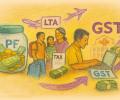
rediffGURU T S Khurana answers readers' personal income tax queries

They are not just underreporting income; they are reshaping what the income tax system perceives, says study.

'Users should protect their savings goals before allocating money to discretionary expenditure.'

'Despite a challenging FMCG environment, ITC Foods has grown at or above the industry rate.'

Have income tax-related questions? Ask rediffGURUS Mihir Tanna, Vipul Bhavsar, T S Khurana, Vivek Lala and Anil Rego.

Anil Rego, CEO, Right Horizons, answers your personal income tax queries.

rediffGURU Vipul Bhavsar answers readers' personal income tax queries.

Here are the key numbers to watch out for in the Union Budget for 2025-26:

rediffGURU T S Khurana answers readers' personal income tax queries

The government should refrain from raising income tax surcharge on the super-rich and reintroducing wealth tax in the upcoming 2026-27 Budget, as the move could prompt persons in high-income brackets to leave the country for low-tax jurisdictions, according to tax experts.

Taking both direct and indirect taxes, the gross collection is expected to grow 10.45 per cent to Rs 33.61 trillion in 2023-2024.

Godrej Consumer Products Ltd (GCPL) delivered a robust Q4FY26 performance, with steady demand in India and signs of stabilisation in international markets, despite persistent inflationary pressures. The company expects to maintain profitability in FY27 through strategic cost management and pricing adjustments.

Some of the policy measures announced are expected to go a long way in removing current challenges on financing faced by businesses and also increasing economic activity, especially in areas of construction and manufacturing.
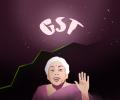
Can this growth in GST collection be sustained in the coming years? asks A K Bhattacharya.

rediffGURU Vipul Bhavsar answers readers' personal income tax queries.
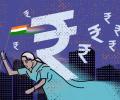
Ask tax gurus Mihir Tanna, Samkit Maniar, Vivek Lala, Anil Rego, T S Khurana and Mahesh Padmanabhan your Budget-related tax questions

Finance Minister Nirmala Sitharaman's biggest challenge will be to find a new growth driver, particularly against the backdrop of a global economy ravaged by heightened uncertainty and fragmentation, financial markets on a precipice, and global commodity prices on a continued uptrend.

Kanpur Police solved a robbery case leading to the discovery of a large hawala network. Six people were arrested, and investigations are ongoing to uncover the full extent of the illegal financial activities.

The reduction in goods & services tax (GST) on individual life and health insurance premiums has been called a "landmark step" for making insurance affordable and inclusive. In a panel discussion at the Business Standard BFSI Insight Summit 2025, Anup Bagchi, managing director (MD) & chief executive officer (CEO) of ICICI Prudential Life Insurance; Mahesh Balasubramanian, MD & CEO of Kotak Life Insurance; Tarun Chugh, MD & CEO of Bajaj Life Insurance; and Ratnakar Patnaik, MD of Life Insurance Corporation of India (LIC), listed what else the industry needs to reach more people.

The reduction in the goods and services tax (GST) rates has increased the momentum in India's economic activity both on the supply and demand sides, while robust agricultural activity - reflected in the strong onset of rabi sowing and adequate reservoir levels - has reinforced the outlook for food supply and rural incomes, the finance ministry said on Thursday.
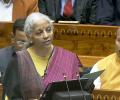
Budget 2026 sticks to fiscal discipline, shuns populist measures despite five key state elections coming up, but ends up rattling stock markets with a higher transaction tax on derivatives trading.

The idea of back-loading the target of fiscal consolidation is perhaps guided by the government's desire to be prepared for any adverse developments in the coming year, points out A K Bhattacharya.

These changes certainly bring India's GST a lot closer to what an ideal GST would look like, points out Karan Bhasin.

Is the parabolic rise in silver running out of steam or just getting started? Ramalingam Kalirajan offers his take on if you should invest in silver now?

'The trade deficit in some sectors is huge and that is an area of opportunity to localise.'

The Indian government has expressed its disagreement with the IMF staff's 'baseline' assumption that the 50 per cent US tariffs on its goods exports 'would remain in place indefinitely', based on which the staff pegged the country's GDP growth at 6.6 per cent this year, and pared its 2026-27 projection by 20 basis points to 6.2 per cent.

Rural India outpaced urban centres in passenger vehicle sales in 2025, recording a growth of 12 per cent compared with 8 per cent in cities.
Net direct tax collection in the eight months of the current fiscal touched 58.34 per cent of Budget Estimates (BE) at Rs 10.64 lakh crore. The net tax collection for April-November stood at Rs 10.64 lakh crore, which is 23.4 per cent higher than the corresponding period of last year, the ministry of finance said.
The gross tax revenues have touched 65 per cent of the Budget estimates at Rs 17.81 lakh crore during the first eight months of the current fiscal till November, propelled by corporate and personal income tax mop-up, according to the Economic Survey 2022-23 presented in Parliament on Tuesday. The survey, authored by Chief Economic Advisor V Anantha Nageswaran, said the 'substantial reforms' in India's taxation ecosystem post-2014 and policy reforms have removed the distortionary incentives from the economy. Reforms like GST, reduction in corporate taxes, exemption of sovereign wealth funds and pension funds from taxes, and removing Dividend Distribution tax have reduced the tax burden on individuals and businesses.
Direct tax collection, net of refunds, moderately exceeded the revised estimates (RE) for the financial year 2023-24 (FY24) on the back of personal income tax revenues, but corporation tax receipts fell short of the RE. Net direct tax collection stood at Rs 19.58 trillion in FY24, surpassing the RE of Rs 19.45 trillion by Rs 13,000 crore, or 0.7 per cent. The government had revised up FY24 projections for personal income tax by 13.5 per cent over the Budget estimates (BE) of Rs 9 trillion, at Rs 10.22 trillion.
The net direct tax collection so far this fiscal rose 19.41 per cent to Rs 14.70 lakh crore, reaching about 81 per cent of the full-year target, the income tax department said on Thursday. "The provisional figures of Direct Tax collections up to January 10, 2024, continue to register steady growth," the Central Board of Direct Taxes (CBDT) said in a statement. Direct Tax collection, net of refunds, stood at Rs 14.70 lakh crore which is 19.41 per cent higher than the net collection for the corresponding period of last year.

'We kept this Budget on a larger plank, rather than on one incident, however serious.'
